
There are many different designs, and it is not a question of whether it’s possible to build a quantum computer, but what’s going to be the best way. – John Morton, Quantum Motion
Setting the scene for a quantum shift
Quantum computing has reached a pivotal moment. Among the many physical qubit technologies, semiconductor spin qubits are rapidly moving from research niche toward engineering reality. At this year’s Silicon Quantum Electronics Workshop, researchers from leading companies, universities and national laboratories like Charles Tahan from Microsoft consistently remarked:
The next five years will bring more progress than the last twenty-five.
That level of confidence signals how much the landscape has changed. Spin qubits are transitioning from laboratory milestones to a realistic platform for large scale quantum systems.
From proof-of-concept to scalable engine
We have the industry’s first quantum processor unit, a fully programmable full stack quantum computer that was made using industrial silicon transistor technology. – John Morton, Quantum Motion
What is driving that shift? The hardware. Quantum dots are now routinely fabricated on 300mm wafers, leveraging advanced industrial semiconductor lines and bringing the promise of scale at small size and small cost. At the same time, single-electron spin control, two-qubit exchange coupling and advanced read-out technologies are showing rapid fidelity and coherence improvements.
Control systems are also advancing in ways that match the pace of device progress. The hardware that manages pulses, timing and measurement has long been one of the biggest challenges in spin qubit research.
Today, new platforms bring tighter synchronization, more efficient pulse delivery and faster iteration cycles. This alignment between device performance and control capability is one of the clearest indicators that the field is entering a more mature phase.
Why semiconductor spins stand out
This technology has advantages that are easy to understand and hard to ignore. It benefits from decades of semiconductor manufacturing, long coherence times enabled by isotopic engineering, and the size, speed, and fabrication cost lending to scalable architectures in affordable systems. These strengths explain why so many researchers now see semiconductor spins as a leading candidate for large scale systems.
Open source tools accelerating the field
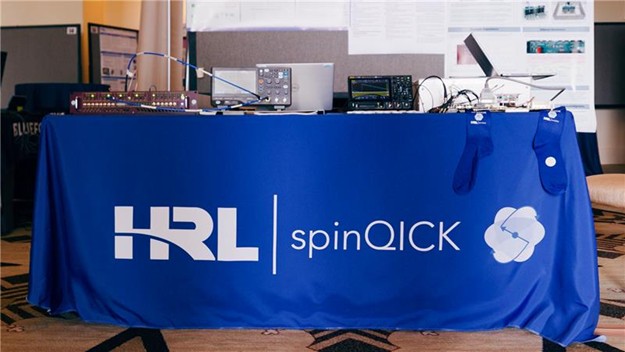
One of the most encouraging trends is the move toward open, accessible tooling. HRL’s spinQICK initiative is an example of this shift. Built as an open-source extension to the Quantum Instrumentation Control Kit, spinQICK gives researchers a practical way to run spin qubit experiments on low cost RFSoC hardware.
- It supports initialization, read out, calibration and basic qubit operations, making it easier for universities and labs to participate in the field.
- Programs like this help build a broader ecosystem and lower the barrier to entry for new contributions
Looking ahead
The momentum behind spin qubits is growing, and the direction of travel is becoming clearer. Breakthroughs in fabrication, control and collaboration are converging in ways that were hard to imagine even a few years ago. The community’s confidence is rising because the progress is real.
What comes next will be shaped by continued partnerships, open tools and steady engineering. The future of quantum computing will depend on the choices made now, and semiconductor spin qubits are positioned to play a central role in that future.
“While it’s not obvious exactly which specific semiconductor approach is going to be the one that takes us there, one of them will. And, I think, we’re all going to help each other along this ride to get there. – Thaddeus Ladd, HRL Laboratories, LLC “
HRL Laboratories, LLC, California (hrl.com) pioneers the next frontiers of physical and information science. Delivering transformative technologies in automotive,aerospace and defense, HRL advances the critical missions of its customers. As a private company owned jointly by Boeing and GM, HRL is a source of innovations that advance the state of the art in profound and far-reaching ways.
Media Inquiries: media[at]hrl.com, (310) 317-5000