
Quantum computers are more than just qubits. To operate at scale, they require control systems that are as manufacturable and precise as the qubits themselves. Published in Nature, HRL’s quantum processing unit integrates its control hardware inside the cryostat with a digitally programmable custom chip manufactured at a commercial foundry. The system achieves control errors ten times lower than any prior exchange-only demonstration and runs error-correcting codes autonomously.
HRL Laboratories achieved a quantum computing milestone: a quantum processor integrating qubits, interconnect, and control hardware that are all built with the same semiconductor manufacturing techniques used to make conventional computer chips. Reported in Nature, the system links a low-noise silicon spin qubit chip to a cryogenic CMOS controller through a superconducting ribbon cable. The controller generates all qubit control signals, with errors an order of magnitude lower than previous results using this qubit type, and runs error correction circuits autonomously with no real-time input from room-temperature electronics.
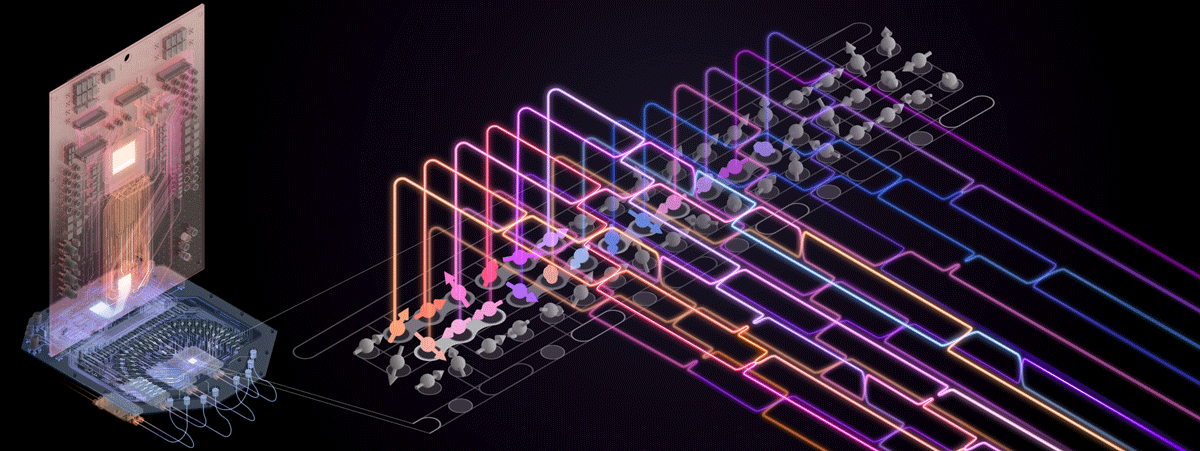
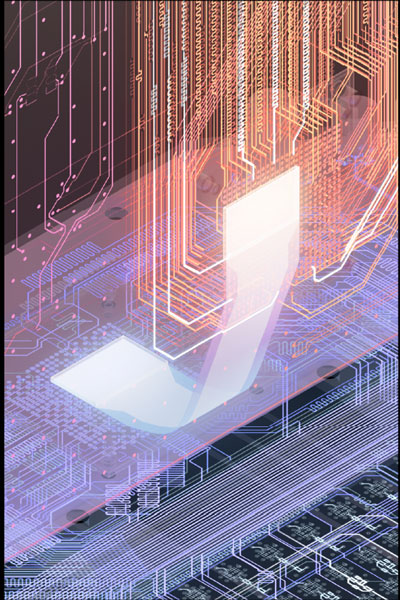
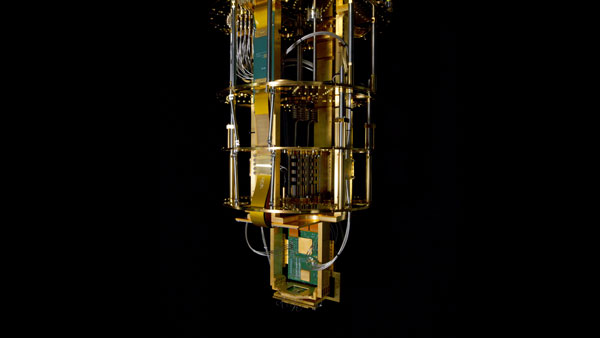
The work addresses a central obstacle for all quantum computing platforms: how to control the enormous number of qubits that a useful machine will require without an unmanageable tangle of wiring and electronics. HRL’s answer is to replace the racks of conventional control electronics otherwise required with a single custom CMOS chip that they put inside the cryostat, near the qubits. That location would normally create a new problem: although the controller is kept very cold — much colder than the point where air freezes to a solid — it is warm relative to the qubits, which sit near absolute zero. HRL’s superconducting ribbon cable is what makes the architecture work, transmitting the hundreds of control signals generated at the controller’s temperature down to the colder qubits, without carrying the heat.
“We’re proud of each of the system components. Any one of them could have been the headline. But what made this result possible was getting them all to work together as one,” said Dr. Matthew Reed, Chief Scientist of the Solid-State Physics Division at HRL and overall technical lead for the work. “For example, conventional wisdom in quantum computing says you could never put a computer chip drawing an amp of switching current inches away from a quantum device and keep it coherent. Spin qubits are among the world’s best broadband electrical noise sensors — and you want to wire them straight into that? Preposterous. But the team made it work and solved a dozen other problems just as hard.”
The ability to manufacture cheaply and at scale is why the transistor, the integrated circuit, and silicon CMOS each came to dominate conventional computing. HRL is betting that quantum computing will be no different. In its vision, every part of a large-scale machine would come off a semiconductor production-line, keeping costs manageable and broadening the range of problems for which the technology is economically worthwhile. Silicon qubits also operate quickly enough that error-corrected computations, which require trillions of operations, will complete in time to be useful.
How it works
The processor uses “exchange-only” qubits, each of which stores quantum information in the combined spin state of three individual electrons trapped in a silicon chip. Most qubits require high-frequency analog control, such as precisely shaped microwave pulses for superconducting qubits or low-noise, high-power laser beams for trapped ions and neutral atoms. HRL’s qubits instead require only simple voltage pulses: signals so similar to ordinary transistor outputs that a conventional CMOS chip can generate them directly, with minimal power and complexity.
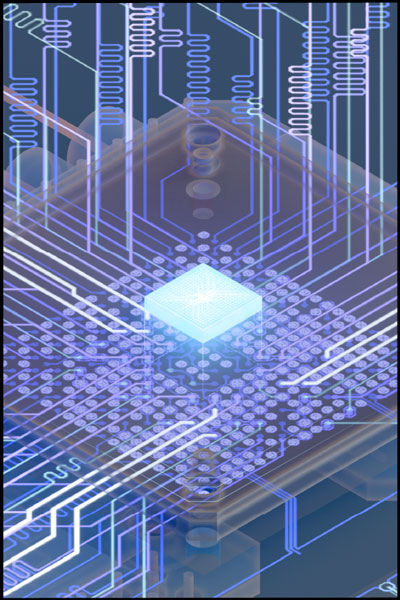
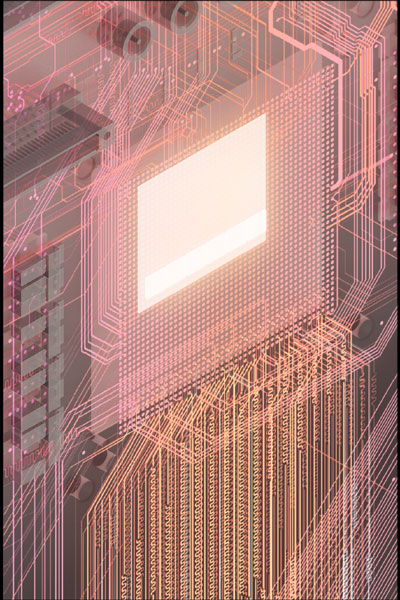
That simplicity is what lets a single 70-million-transistor chip serve as the entire control system for 18 qubits. The chip consumes less than 3.5 W, little enough to operate near the qubits, inside the cryostat at the 4 K (about −452 °F) stage. Once a digital program is loaded into on-chip memory, the processor needs nothing from room temperature but power, a clock, and reference voltages. The chip’s hundreds of signal outputs are routed through a superconducting ribbon just a centimeter wide, which transmits them to the qubits at the millikelvin stage.
The qubit chip itself also represents a major breakthrough. Exchange-only spin qubits have long been seen as an elegant idea that would be challenging to achieve given the realities of the underlying materials science. Achieving acceptable levels of device noise and ensuring the qubit’s quantum states are cleanly separated from unwanted ones have been fundamental obstacles that the scientific community has worked to overcome for more than a decade. In this work, HRL demonstrates solutions to both. Errors due to intrinsic device charge and magnetic noise are more than 100 times lower than previously shown, collectively contributing only 0.02% to absolute entangling gate error. HRL also developed a wafer-scale process that raises the device’s “valley splitting” to a consistently high value. Conventionally, this quantity varies randomly from site to site, sometimes settling on a very small value that breaks an unlucky qubit, limiting how large a usable device can be. Here, HRL saw no evidence that low valley splitting affected performance in any of its devices.
Error correction on autopilot
To evaluate how the processor performs, HRL ran error correction routines, the foundation of any large-scale quantum machine. These included a distance-5 repetition code across seven qubits and a [[4,2,2]] error-detection code (a four-qubit code encoding two logical qubits) that preserved logical information after three rounds of error detection with roughly 95% fidelity. A single instance of the repetition code involved hundreds of thousands of operations, all executed autonomously from the chip’s own digital memory.
“Error correction isn’t one technique, it’s many running at once: entangling gates firing in parallel, scheduling dynamical decoupling on idle qubits, and measuring and resetting others mid-circuit,” said Dr. Jacob Blumoff, technical lead for multiqubit operations. “Each of those has its own optimizations and constraints, and getting them all to coexist cleanly, over hundreds of rounds, was a big part of the work.”
Individual gate operations were by far the most accurate ever shown for this type of qubit, with errors averaging 3×10⁻³ for entangling gates and 2×10⁻⁴ for single-qubit operations. The team also showed that “leakage,” where a qubit strays out of its computational states, can be removed as it occurs rather than accumulating over a computation — a long-standing concern for this modality. The gate fidelities are limited by engineering factors like signal integrity and calibration, not by the qubits’ underlying physics. With no fundamental ceiling in sight, HRL expects errors to keep falling through iterative development.
“The real test of error correction is whether the errors shrink as the code grows,” said Dr. Thaddeus Ladd, Chief Scientist of the Computational Physics Division and technical lead of the theory and modeling effort. “Going from the smaller repetition code to the larger one, the errors dropped by about a factor of five. The performance also matched what our models predicted, which is what gives us confidence the approach will keep working as we scale.”
Why it matters
 HRL’s result arrives amid a global race to build a useful quantum computer. Companies such as IBM and Google have heavily invested in qubits based on superconducting electrical circuits. These are similar to spin qubits in that they are also a solid-state, cryogenic modality, but are more mature in part due to their lower barrier to entry and larger research community. Qubits can also be formed by trapping individual atoms in free space and manipulating their state with lasers — whether ionized, as in the case of Quantinuum, or neutrally charged, as with QuEra. These types of qubits show promise for scaling and benefit from flexible long-range connectivity, but are much slower to operate than solid-state alternatives.
“When weighing the initial promise of the spin qubit, we started considering the possibilities of a RISC strategy — reduced instruction set computing,” said David DiVincenzo, co-author of the original exchange-only proposal in 2000. “Exchange-only was the answer, at the price of three electrons rather than one and much longer gate sequences. But it got rid of the enormous complexity of large, localized, and precisely timed AC and DC magnetic fields. That complexity is manageable for small systems, but when you seriously consider building something big, the value of simplified control becomes apparent. After many years of preparatory work, HRL has made this promise a reality. The simplicity of control means they do what no other modality has achieved: replacing racks of room-temperature electronics with one control chip placed close to the qubits.” The RISC philosophy, where hardware primitives are simplified but more of them are used per operation, eventually came to dominate conventional processor design.
Control hardware simplicity isn’t the only advantage of exchange-only qubits. They also enjoy some of the strengths of both superconducting and atom-based modalities: speed and manufacturability as well as the ability to dynamically reconfigure how qubits connect to one another. HRL’s processor achieves this flexibility by efficiently swapping quantum states between neighboring qubits, rather than physically repositioning them as atom-based machines do. A paper from the Vandersypen group at QuTech appears in the same issue of Nature and demonstrates an alternative approach closer to the atomic one: physically shuttling an electron through a silicon array to connect otherwise-distant qubits. The group uses this technique to carry out parity-check measurements, a critical building block of error correction. HRL and QuTech are not alone: established semiconductor players such as Intel and imec, along with newer companies like Diraq and Quantum Motion, are pursuing silicon spin qubits as well.
About HRL Laboratories
HRL is at the forefront of quantum science and engineering, pushing the boundaries of what’s possible in computing and networking. To learn more about HRL’s areas of expertise, state-of-the art facilities, research approach and future opportunities, visit us here.
About Nature
Nature is a weekly international journal publishing the finest peer-reviewed research in all fields of science and technology on the basis of its originality, importance, interdisciplinary interest, timeliness, accessibility, elegance and surprising conclusions. Nature also provides rapid, authoritative, insightful and arresting news and interpretation of topical and coming trends affecting science, scientists and the wider public.
HRL Laboratories, LLC, California (hrl.com) pioneers the next frontiers of physical and information science. Delivering transformative technologies in automotive,aerospace and defense, HRL advances the critical missions of its customers. As a private company owned jointly by Boeing and GM, HRL is a source of innovations that advance the state of the art in profound and far-reaching ways.
Media Inquiries: media[at]hrl.com, (310) 317-5000